
The history of personal productivity for people seeking high leverage out of their day is a cycle of failed attempts to automate human action without regard for taste. In today’s world, most of the Product leaders that I talk to are talking about creating a Personal OS. A force multiplier that helps them maximize their impact while minimizing the headaches of modern life.
Back in the early 2000s, as people started to get their first, second and third email addresses from AOL, CompuServe, their school, or work, their email contacts were spread out across a variety of clients and services. Plaxo, a service by Sean Parker, achieved one of the first true viral loops by promising to solve the fragmentation of personal contact management.
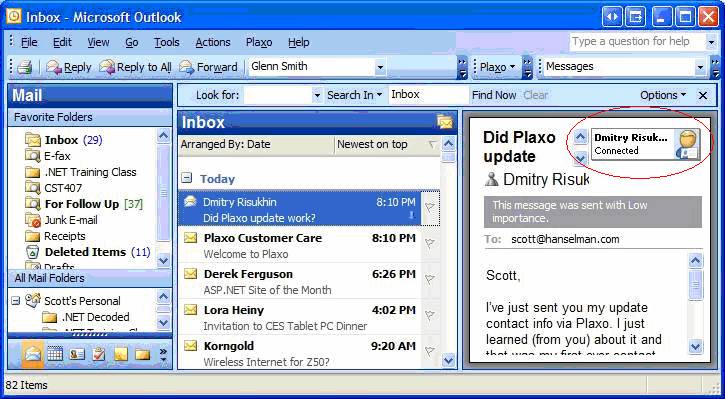
The early dream of automated contact management integrated directly into the workflow. Source: Scott Hanselman
They were mostly successful in aggregating an initial personal contacts database across silos of school, work, and some personal email services. The talk around the valley among leading technologists shifted to creating a Personal Relationship Manager (PRM) on top of this new wealth of data.
Ostensibly, the goal was to create leverage and social capital by automating the work of remembering birthdays and tracking news. While the idea was viral, the value was hollow. Automated messages felt scripted because they prioritized the completion of the task over the authenticity of the connection. The era of Plaxo and the PRM taught us that blind aggregation and automation without authenticity and taste turns connection into spam.
The Context Fragmentation Tax
The SoLoMo (Social Local Mobile) era, a term coined by John Doerr, put the world in our pockets. The mobile revolution connected everyone to each other while simultaneously establishing the technical infrastructure for daily digital existence. However, it perpetuated a new problem where data became trapped in fragmented stores like iMessage, Slack, and Email. We solved the problem of connecting people and devices but we created the problem of disconnected data trapped within individual apps.
Today, in the absence of a unified context layer, high-leverage leaders who want to maximize the impact of AI face five structural hurdles:
-
The Manual Routing Tax: Users act as information janitors, manually copying data between silos to maintain a coherent view of reality. This is a functional friction that wastes high-leverage time.
-
The Privacy Trade-Off: Users are forced to choose between utility and privacy. You can use integrated cloud ecosystems that offer magical convenience but require total data exposure, or you can use encrypted silos that are secure but “dumb” because they can’t talk to each other. There is currently no middle ground that offers both intelligence and sovereignty.
-
Context Amnesia: Siloed data has no memory. Every time you switch apps, your digital brain resets to zero. You have to re-explain your context to every new tool because the system lacks a persistent memory layer.
-
Incentive Misalignment: Current apps are optimized for engagement (time on site), not utility (time saved). It is not strategically rational for most apps to freely share their context with an aggregator, as their business model depends on keeping you inside their walled garden.
-
The Legacy API Bottleneck: Industry attempts to solve this via APIs or protocols (like MCP) are slow to take hold. Real-world tasks—like pulling lab results from a patient portal—often rely on legacy systems that will never offer clean APIs for a user to access programmatically.
For the power user looking to create leverage, operating within these constraints is a legacy state that talent should outgrow. This demand has given rise to the concept of a Personal OS—a unified intelligence layer that sits above your apps to extract signal from the noise.
ClawdBot Moltbot represents a Fundamental Architectural Shift
The emergence of Agents like ClawdBot Moltbot that create unified context represents the first architectural shift designed to solve this context routing issue. The ClawdBot Moltbot project went viral in technical circles by promising to bridge these gaps. Developed by Peter Steinberger, this open-source agent allows all of a user’s context—work, personal, and team—to be looked at holistically. (Note: During the drafting of this post, the project was renamed from ClawdBot to Moltbot).
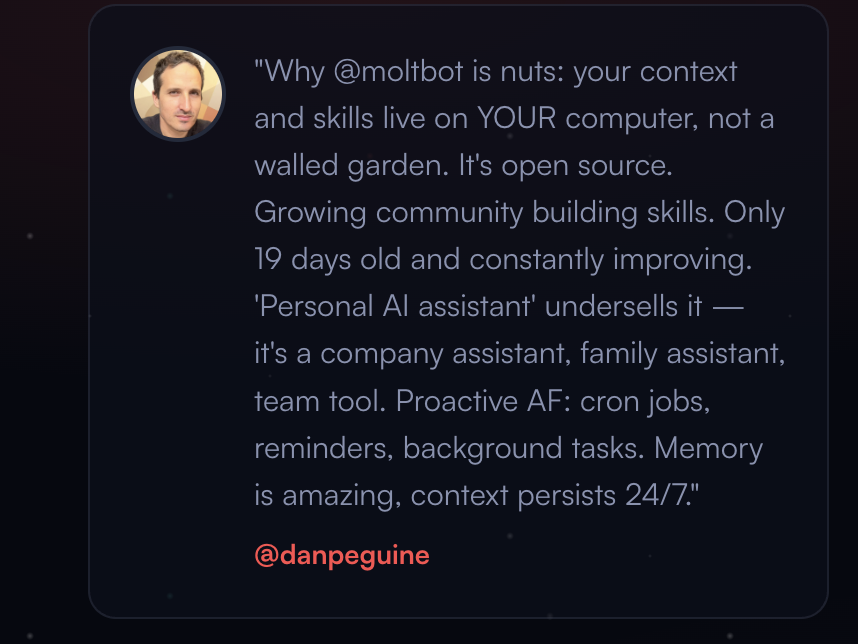
Early adopters identify the transition from a 'personal assistant' to a proactive context-persistent tool. Source: @danpeguine
Moltbot accesses “raw metal” to bridge silos, unbound by any single vendor or API. It can run locally or on a private VPS, giving the user control over where their data lives.
Two interesting notes from this are that people are running ClawdBot Moltbot on Mac minis rather than a $5 VPS. My thesis is that this represents a deep-rooted user desire for privacy. While the Overton window has shifted a little bit in terms of social privacy and what people are willing to share on the web, there is an inherent desire to keep some information private.
Second interesting note, while this maybe an artifact of the early adopter community, is the user’s desire for Ownership over the digital means of production. This ownership is a strategic imperative. If you don’t own the data graph, you cannot compound its value. It’s perhaps the realization of the strategic value of switching cost created by time. This is the Lindy Effect applied to personal context. As the agent ages, it becomes more valuable. Once an agent knows a deal history and decision logic spanning a decade, it becomes an irreplaceable asset. That the early adopters are choosing to put this on a local machine that’s completely under their control signals a shift toward sovereignty.
For the Personal OS to become a reality, the industry must solve the critical problems identified by Moltbot’s early adoption
While the desire for a unified context is clear, the path forward is unpaved. The success of Moltbot proves that users are willing to tolerate friction to gain agency, but for this to scale beyond the technical elite, we must resolve four fundamental issues.
1. Table Stakes: Friction, Sovereignty, and Security The first set of issues are foundational table stakes. First, the setup barrier must be eliminated; a normal user will never configure a local server or manage API keys. Second, we cannot trade the “many small jails” of app silos for the “one big jail” of a vendor-locked Personal Context Cloud. Users need data sovereignty—the ability to own, export, and control their context graph. Finally, the “Open Shell” model of current local agents is a security non-starter. The industry must standardize a secure perimeter that authorizes an agent’s intent without giving it a blank check to every file on the system.
2. The Real Challenge: Expansion over Mimicry Once the foundation is secure, the true strategic challenge is style. Current AI models regress to the mean, producing generic prose that sounds like everyone else. A Personal OS that simply mimics your past behavior traps you in your own history.
To act as a true force multiplier, and not just go the way of Plaxo and the PRM, the agent must enable Expansion. It should not just replicate how you have written; it should help you express how you intend to write. I once lost a rental deposit because I didn’t fully know my rights. An expansion-focused agent would have flagged that knowledge gap instantly, using my context to arm me with the specific legal leverage I lacked. The goal is not to outsource and automate your voice away. Your personal OS should amplify your full potential and help you be all that you can be, rather than just a faster version of who you were yesterday.
3. The Vanity Trap If we fail to solve for expansion, we fall into the trap of Vanity Productivity. This is the risk of mistaking the feeling of generated copious output and iterations with the agent for achieving the reality of a strategic outcome. The real risk is becoming irrelevant because your competitor’s agent is negotiating better deals than you are. Without a focus on leveraging human potential, the Personal OS becomes an engine for generating noise, allowing users to feel productive while achieving nothing. The metric of success must shift from “actions taken” to “leverage gained.”
The Strategic Payoff
The objective is to make the user more present, allowing them to fully express themselves in ways never before possible rather than simply becoming a just more productive cog in a wheel. ClawdBot Moltbot isn’t just an app; it is the first credible blueprint for this shift from manual routing to personal sovereignty.
And once we solve this for ourselves, the next frontier is what happens when our agents start talking to each other. How are you architecting your own digital factory? Are you building an irreplaceable moat, or just adding to the noise?
Join the discussion on LinkedIn.