
Last month, I outlined the four pillars driving the longevity revolution. I expected them to mature over the coming year. I didn’t expect to see three of them validated in the first three weeks of January.
Recap: The Four Pillars
To ground this month’s updates, let’s look at the innovation stack I outlined in December:
- Decoding Cellular Aging: Targeting the fundamental biology of decline (See my technical deep dive on advances in Pillar 1 foundational biology here).
- Democratizing Access: Moving clinical-grade diagnostics into the consumer’s hands.
- Personalization at Scale: Using AI to orchestrate unique, data-driven health plans.
- Real-Time Adaptation: Moving from static plans to living, breathing feedback loops.
In just the last few weeks, we’ve seen significant moves that validate Pillar 3 (Agentic AI) and Pillar 4 (Real-Time Adaptation), along with a regulatory tailwind for Pillar 2 (Democratizing Access).
1. The Fight for the Health Interface (Pillar 3)
We are seeing a push to own the consumer health interface. This isn’t speculative; it’s a response to a shift in human behavior. According to an OpenAI report from January 6, 40 million people a day are already using AI to get answers about their symptoms and healthcare coverage.
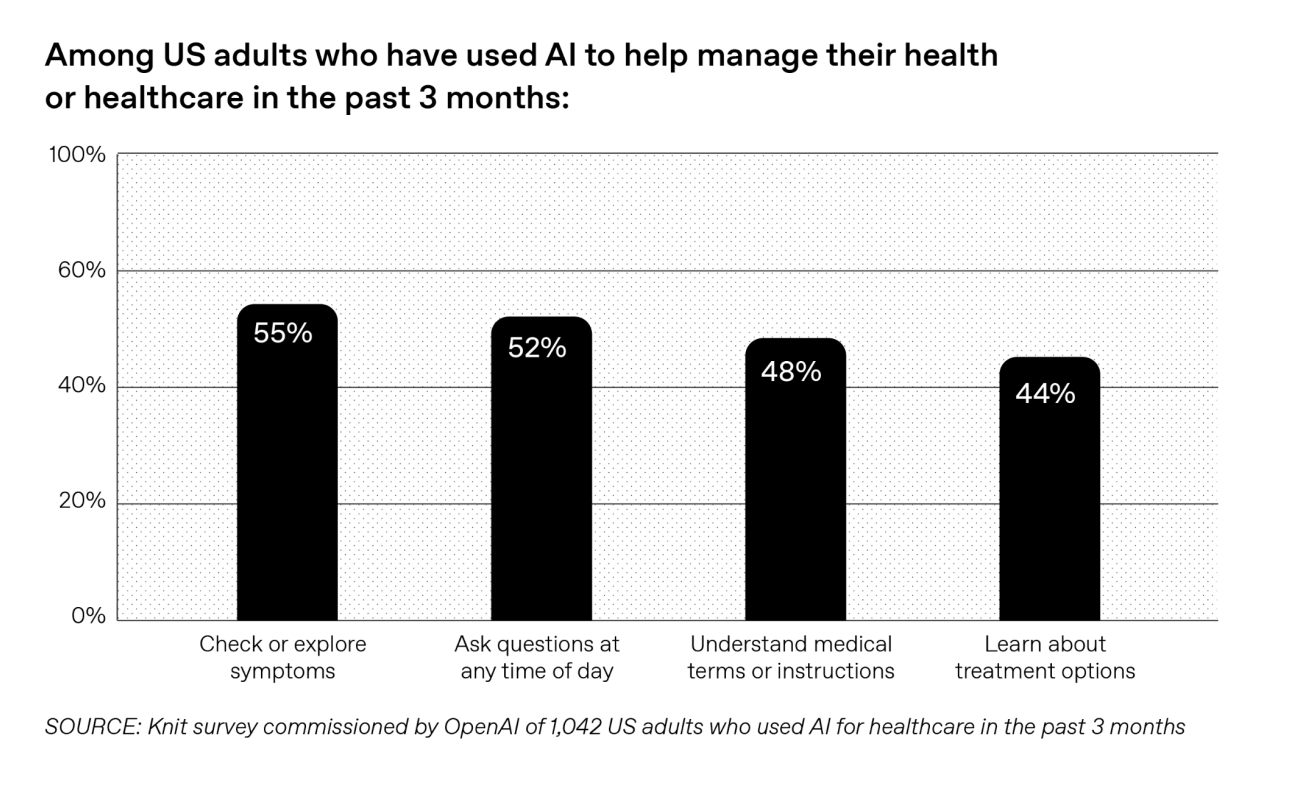 Data from a Knit survey commissioned by OpenAI showing how US adults are using AI for healthcare. Source: OpenAI
With OpenAI’s ChatGPT Health, Anthropic’s clinical integrations, Amazon One Medical’s Health AI, and Google’s Personal Health Agent, the industry is solving the “last mile” problem of health data. These platforms are bridging the gap between “siloed data” and “actionable insights” by aggregating records from lab results (HealthEx/Function) to wearable data (Apple Health/Google Fitbit) and pharmacy records.
This is the democratization of data in action. For years, your Electronic Health Record (EHR) was something you visited, not something you utilized. Now, that data flows directly into the models you use daily, capable of explaining test results in plain language and managing medication renewals in real-time. All these players are adopting a privacy-first approach, stating they will not train models on this private health data. This isn’t benevolence; it’s a market requirement. Without this guarantee, the “consumer health” play is dead on arrival.
While they are competing for the consumer front-end, Anthropic is also tackling the “unsexy” backend. Their expansion into healthcare operations, which includes automating prior authorizations, claims processing, and clinical trial protocols, is the infrastructure layer that makes longevity scalable. By reducing the friction that currently strangles clinical innovation, we accelerate the entire pipeline. Faster trials mean faster therapeutics.
The Insight: The combination of consumer data democratization and backend operational efficiency means the industry is building the “structural rails” for a system that can handle personalized care at scale.
2. From Measurement to Prediction (Pillar 4)
I’ve written before about Making Wearables Useful, focusing on how the initial novelty of seeing “latent data” (like your step count or glucose level) eventually wears off. We are evolving past that phase.
Abbott’s new “Libre Assist” feature is a clear example. Using generative AI, it analyzes your meal photo to predict the spike before it happens, moving beyond simple after-the-fact reporting.
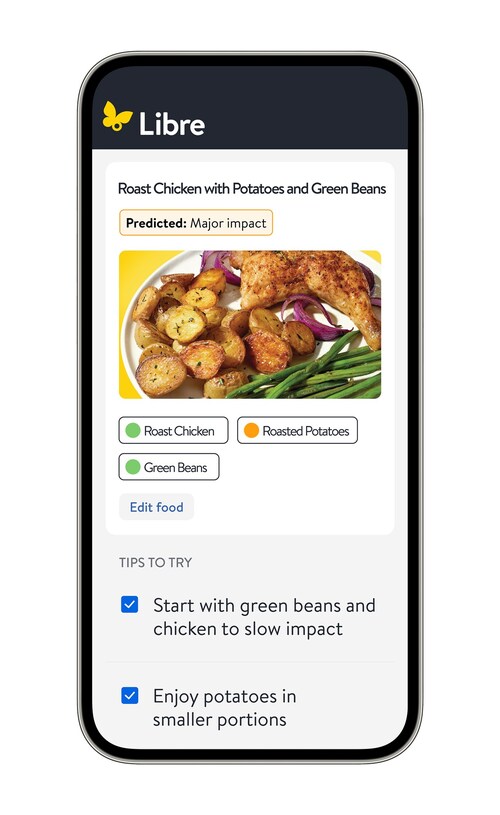
The Abbott Libre Assist interface showing a "Major impact" prediction for a chicken dinner, along with real-time adaptation tips. Source: Abbott
The Insight: This changes the user psychology. Instead of feeling guilty about a spike that already happened, you get a moment of agency. I might still choose to eat that celebratory donut, but knowing the predicted impact, I can plan for a 15-minute walk shortly after to blunt the curve. That shift, moving from retroactive guilt to proactive planning, is the essence of Real-Time Adaptation. It shrinks the feedback loop from two hours (the post-meal spike) to zero minutes (the pre-meal choice).
3. The Regulatory Floodgates Open (Pillar 2)
The biggest bottleneck for health innovation hasn’t been technology, it’s been regulatory ambiguity. That’s why the FDA’s recent announcement (Jan 2026) is so significant.
FDA Commissioner Dr. Marty Makary announced that the FDA will not regulate general wellness products, including devices that measure biomarkers like blood pressure or glucose if they are used for nutritional or lifestyle choices rather than disease management.
The Insight: This “opens the gates” for AI models to predict biomarkers in healthy populations using novel sensors. We can now deploy technologies like PPG to predict blood pressure (without the cuff) or non-invasive glucose monitoring for wellness without the regulatory burden of a Class II medical device.
This creates a lane for the “Quantified Self” to mature into “Quantified Health.” This shifts the risk and the power to the consumer. It allows us to build a “pre-clinical” layer of health data without being strangled by red tape intended for critical care.
The Bottom Line
Structural rails are being laid. The industry now provides personalization (OpenAI/Anthropic/Amazon/Google), prediction (Abbott), and access (FDA). The tools to engineer a personalized healthspan are no longer science fiction; they are here, and they are scaling.