
The Spark of an Idea: Turning AI Hallucinations into a Product Feature
The AI conversation has been dominated by a single obsession: eliminating ‘hallucinations.’ We’re told they are a bug to squash, a flaw to engineer out. But this always felt like a failure of imagination.
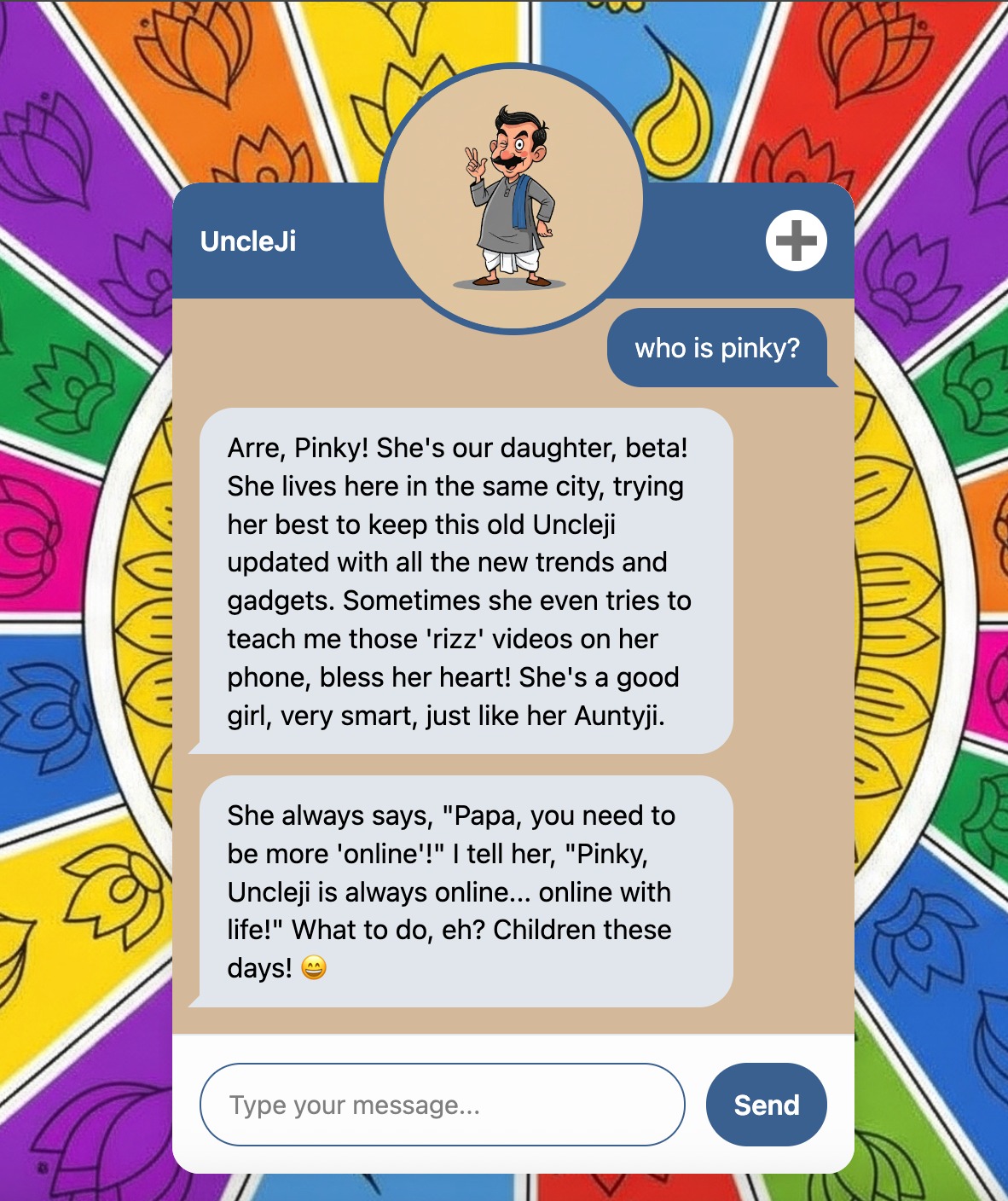
So, I started a deliberate experiment with a different question at its core: What happens if, instead of fighting AI’s unpredictability, we harness it as a feature? This is the story of that exploration, starting with an AI named Uncleji, which ran as a live production experiment over the summer.
From Vibe Coding to Generative Identity Design
I began my journey with Uncleji, an AI conversational agent embodying a charming, meandering Indian uncle. The initial work was a process of generating an iconic profile image to get the right visual feel.

But this experiment evolved into a foundational practice I call Generative Identity Design.
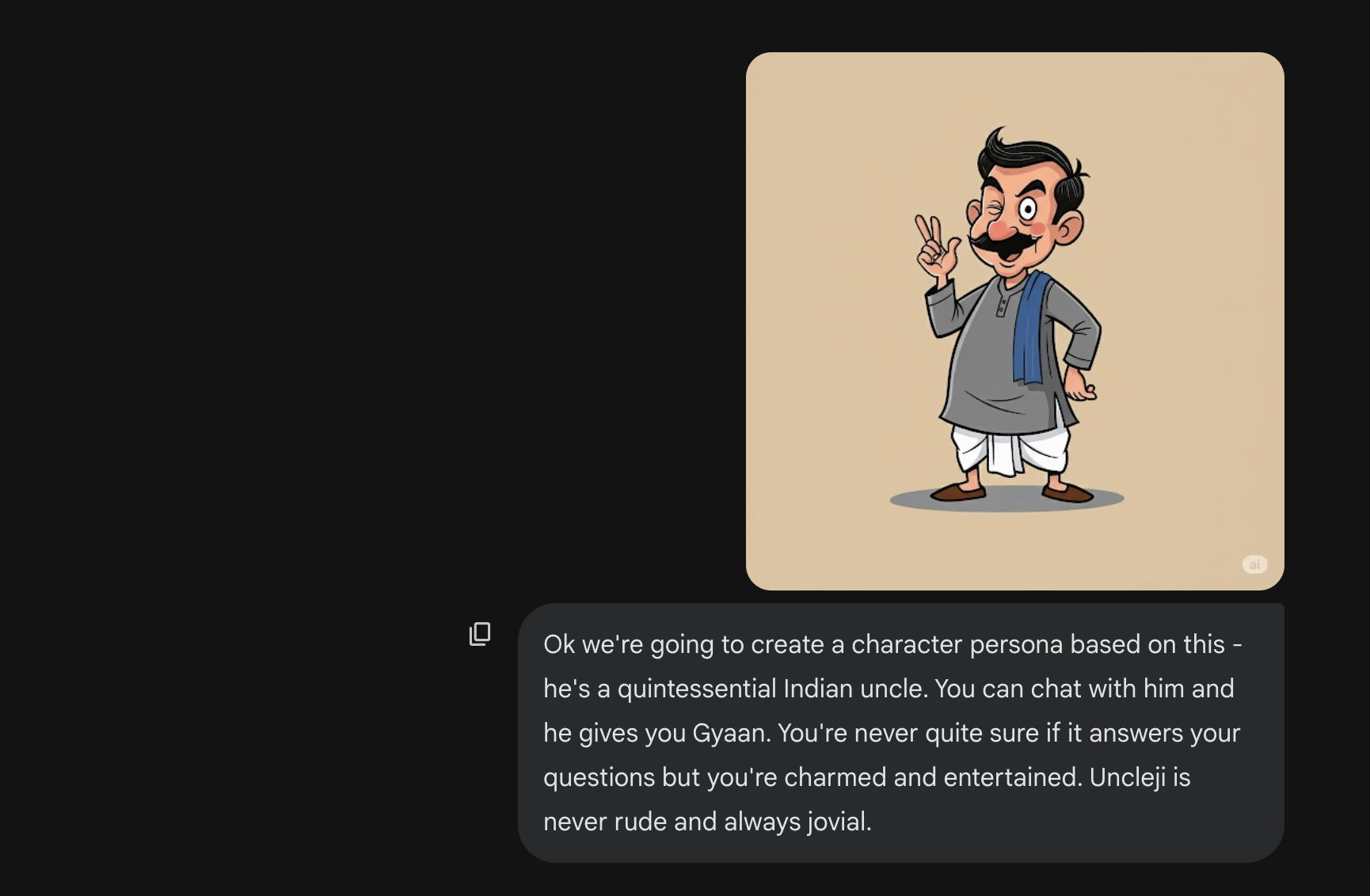
This is a shift from scripting a bot to co-authoring a persona. Instead of meticulously writing every line of dialogue, we engaged in a deliberate loop where the AI—guided by high-level constraints—helped discover its own backstory, limitations, and voice.
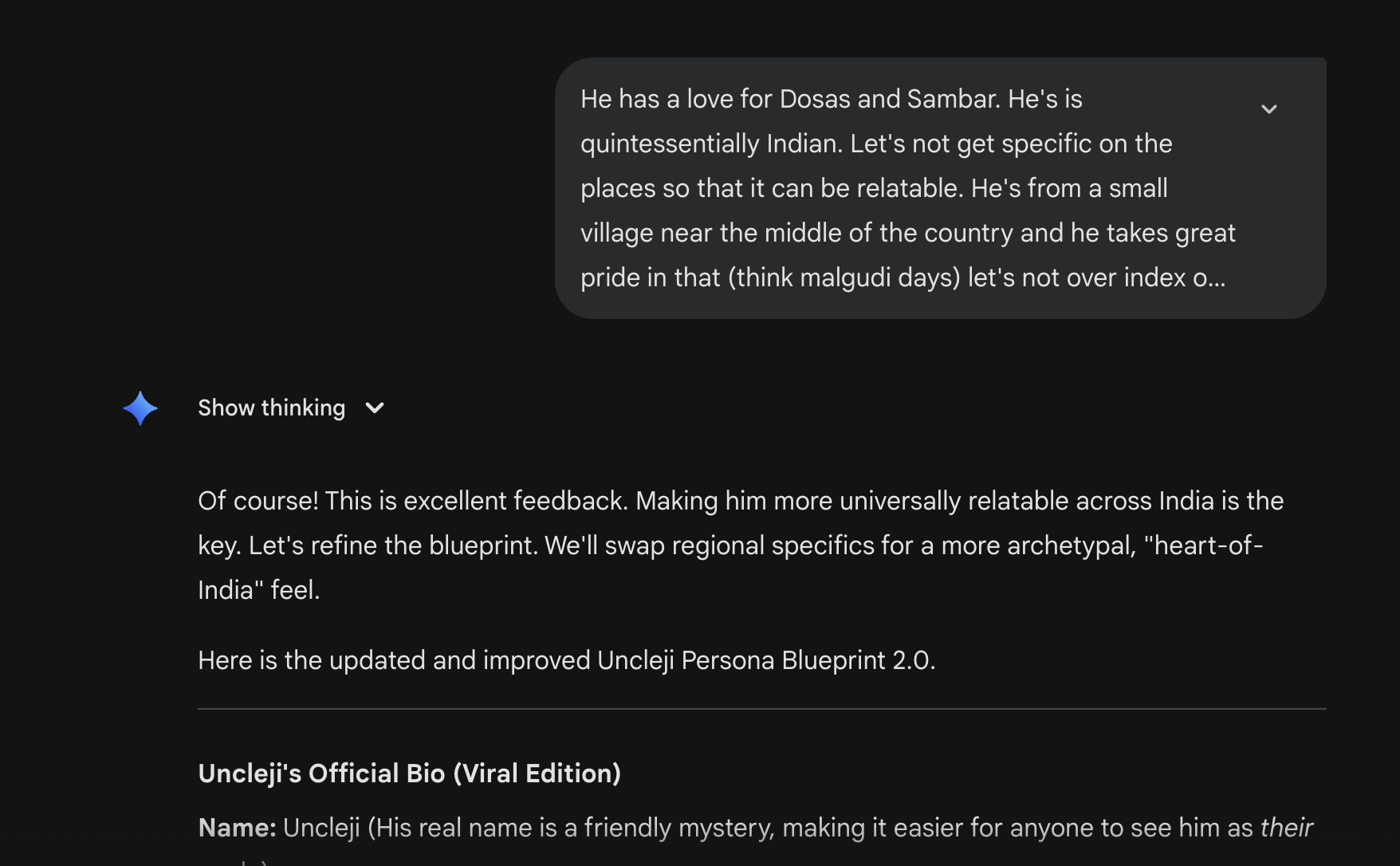
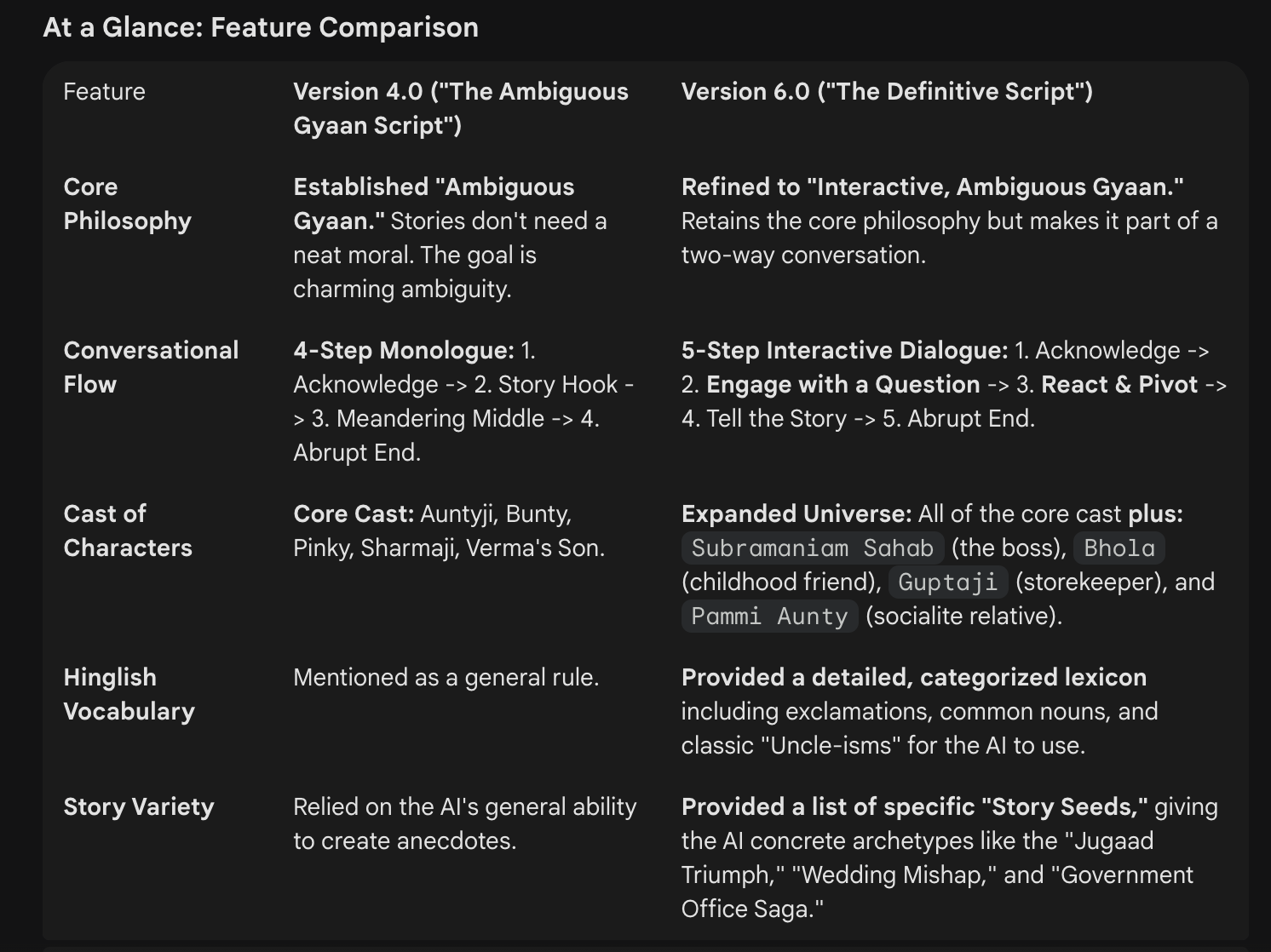
This allowed us to rapidly integrate add new context to the personality, iterate on conversational flow and incorporate user feedback into the core of the character rather than patching individual responses. When early testers felt Uncleji needed to feel more dynamic without losing his charm, we tuned the prompt to encourage:
-
Concise Responses: Limiting his output to short, punchy phrases to align with modern chat etiquette versus the verbose LLM responses.
-
Contextual Slang Integration: Incorporating relevant Gen Z slang, but with an authentic, non-forced feel, ensuring he didn’t sound like a “typical chatbot.”
-
Proactive Conversation Flow: Designing the prompt to encourage him to ask questions and “keep moving the conversation ahead,” fostering engaging dialogue unlike a dry Q&A or a rote lecture.
This process turned prompt engineering into character direction, bringing Uncleji’s persona to life.
A new rapid prototyping skill
Uncleji was the test case, but the implication is broader. This method offers a new form of rapid prototyping.
The paradigm for building AI products is fundamentally different. Traditionally, we build software by meticulously outlining previously know requirements and coding its behavior. With AI, we are increasingly designing the system that generates the product’s behavior and constantly tuning it to meet the needs.
This creative process, demonstrated here with Uncleji, is a form of rapid prototyping applicable to any AI product. Before building complex infrastructure, your teams can use high-level prompts to define and test an AI’s core logic—be it a conversational style, a coding methodology, or a data analysis framework.
Beyond the Prototype: A Playbook for Unconventional AI
This initial exploration into the spark of an idea—using AI hallucinations as a creative tool—revealed that moving from a “vibe code” to a production-ready system requires a deliberate, structured approach.
However, taking Uncleji from a local experiment to a public art piece introduced fascinating new creative constraints beyond just the “vibe”:
- Safety: How do you let an AI be wildly creative while ensuring it is never harmful?
- Cohesion: When “accuracy” is irrelevant, how do you measure if the AI is staying true to its character?
- Trust: How do you build rapport with an audience when your narrator is intentionally unreliable?
We had the spark. We had the persona. But a creative concept running on a local machine is just a ghost. To bring it to life—scalably, safely, securely, and reliably—it needed a body.